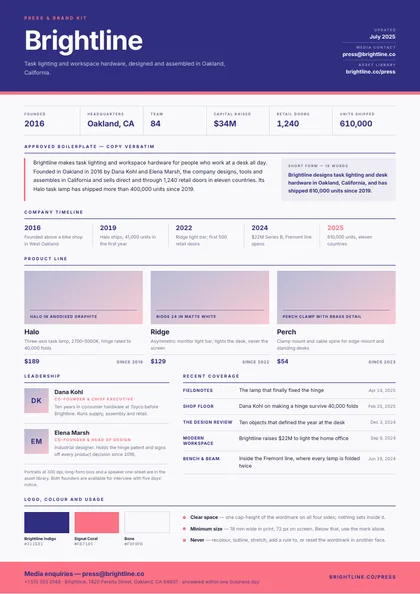
Band header · Indigo & coral · Inter only
expressive A4 portrait 1 page
See the full document
Use this template
Sales & marketing
A media kit sells audience — reach, demographics, placements and rates — laid out so a buyer can price a campaign without having to email back.
3 designs, each a separate take on the same document rather than a recolour of one layout: Band header, Card-grid dashboard and Minimal, type-led. Every preview below is the actual compiled output, not a mock-up.
Open one in the editor and render it from your own JSON over the API — 1 page of A4 portrait, the same engine either way.
Band header · Indigo & coral · Inter only
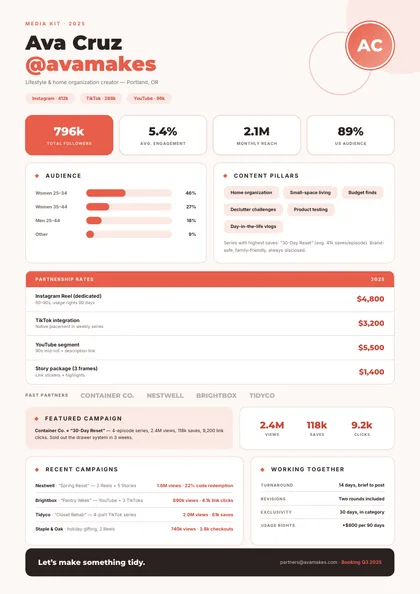
Card-grid dashboard · Aubergine & peach · Montserrat + Inter
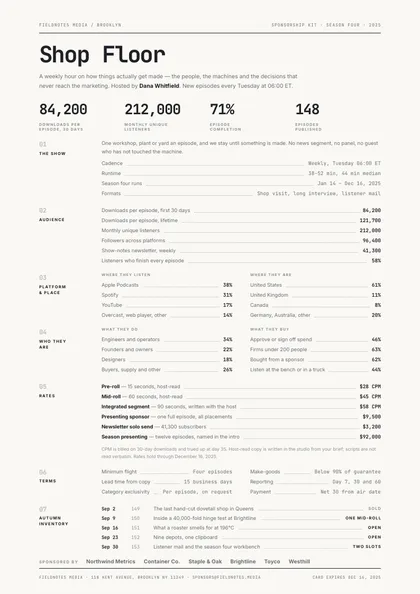
Minimal, type-led · Ink & cream · JetBrains Mono + Inter
Same document, same data model, 3 different arguments about how it should look on paper. Pick on layout and typography — the content behaves identically.
| Design | Layout | Palette | Typefaces | Pages |
|---|---|---|---|---|
| Beacon Band | Band header | Indigo & coral | Inter only | 1 · A4 portrait |
| Creator Coral | Card-grid dashboard | Aubergine & peach | Montserrat + Inter | 1 · A4 portrait |
| Leader Lines | Minimal, type-led | Ink & cream | JetBrains Mono + Inter | 1 · A4 portrait |
Each design is authored against an explicit reflow contract, so it is defined up front which blocks are emitted once per record and which fields absorb longer content. That is what stops the layout falling apart at a hundred rows.
| Design | Repeats per record | Grows with your data |
|---|---|---|
| Beacon Band | fact-strip cells; milestone stops; product cards; leadership entries; coverage rows; colour swatches | boilerplate paragraphs; product one-liners; leadership descriptions; coverage headlines; usage rules |
| Creator Coral | audience bars; content pillar rows; partnership rate rows; past-partner chips; recent-campaign rows; booking terms | bio; featured campaign copy; campaign result strings |
| Leader Lines | audience lines; platform and country lines; role and buying lines; rate lines; term lines; schedule lines | show description; rate footnote; schedule episode titles |
These document sets each include the media kit designs above.
Open a design in the editor and the agent reshapes it around your schema — then render it from your own data over the API, or let your users edit it in the embedded editor.