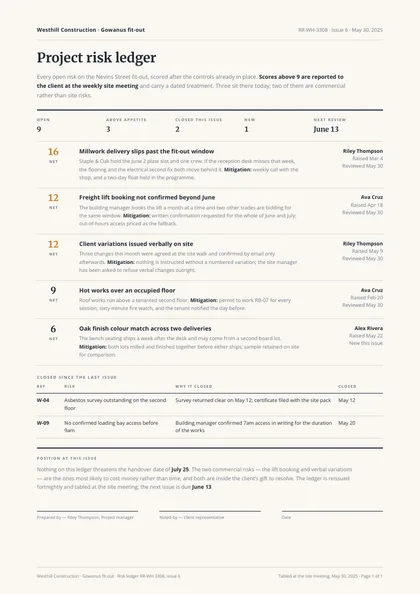
Minimal, type-led · Ochre & ink · Merriweather + Open Sans
conservative A4 portrait 1 page
See the full document
Use this template
Operations
A risk register earns its keep at the review meeting: every open risk scored after controls, with an owner, a treatment and a date — and the ones above appetite impossible to miss.
3 designs, each a separate take on the same document rather than a recolour of one layout: Minimal, type-led, Swiss grid and Card-grid dashboard. Every preview below is the actual compiled output, not a mock-up.
Open one in the editor and render it from your own JSON over the API — 1 page of A4 portrait and A4 landscape, the same engine either way.
Minimal, type-led · Ochre & ink · Merriweather + Open Sans
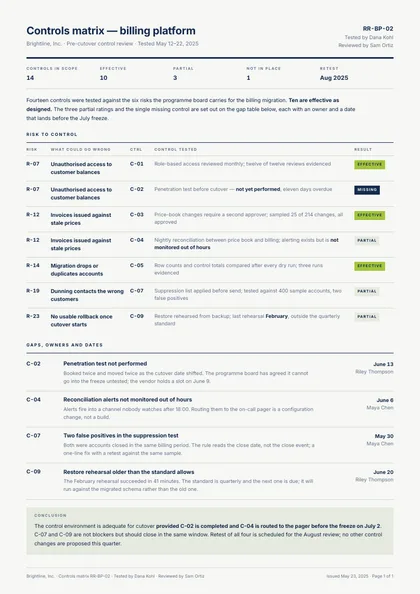
Swiss grid · Cobalt & chartreuse · Inter only
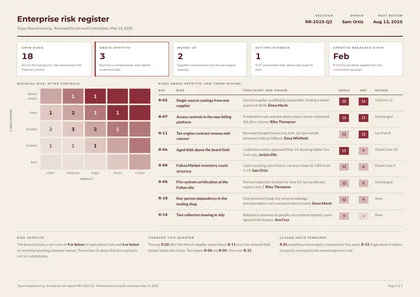
Card-grid dashboard · Oxblood & bone · Montserrat + Lato
Same document, same data model, 3 different arguments about how it should look on paper. Pick on layout and typography — the content behaves identically.
| Design | Layout | Palette | Typefaces | Pages |
|---|---|---|---|---|
| Audit Ledger | Minimal, type-led | Ochre & ink | Merriweather + Open Sans | 1 · A4 portrait |
| Controls Grid | Swiss grid | Cobalt & chartreuse | Inter only | 1 · A4 portrait |
| Heat Matrix | Card-grid dashboard | Oxblood & bone | Montserrat + Lato | 1 · A4 landscape |
Each design is authored against an explicit reflow contract, so it is defined up front which blocks are emitted once per record and which fields absorb longer content. That is what stops the layout falling apart at a hundred rows.
| Design | Repeats per record | Grows with your data |
|---|---|---|
| Audit Ledger | ledger entries; the score cells; the closed-risk rows | every entry's exposure and treatment; the scoring note; the closing paragraph |
| Controls Grid | control rows; the four summary cells; gap rows | every control's description and finding; the scope note; the conclusion |
| Heat Matrix | summary cards; matrix cells; register rows; the movement list | every register row's risk and mitigation; the appetite note |
These document sets each include the risk register designs above.
Open a design in the editor and the agent reshapes it around your schema — then render it from your own data over the API, or let your users edit it in the embedded editor.